

What Is Keyword Cannibalization? Here's How to Avoid Competing With Yourself

You've spent hours writing blog posts, optimizing pages, and building your website. More content should mean more opportunities to rank on Google... right?
Usually, yes.
But there comes a point where adding more content can actually work against you.
If you have multiple pages targeting the same topic, your website may end up competing with itself rather than competing against other businesses. This is known as keyword cannibalization, and while it's one of the most misunderstood concepts in SEO, it's also one that's relatively easy to fix once you know what to look for.
The good news? Keyword cannibalization doesn't happen simply because two pages mention the same keyword. In fact, many websites successfully rank multiple pages for similar searches.
Let's look at what keyword cannibalization actually is, when it's a problem, and how to avoid it.
Key Takeaways
Keyword cannibalization occurs when multiple pages target the same keyword and search intent.
Simply mentioning the same keyword on different pages isn't a problem.
Cannibalization can split rankings, backlinks, and authority between multiple pages.
Google isn't "confused," but it may struggle to determine which page is the best result.
Regular content audits and keyword planning help prevent cannibalization before it starts.
What Is Keyword Cannibalization?
Keyword cannibalization occurs when multiple pages on your website target the same keyword and satisfy the same search intent. Instead of one strong page earning authority and climbing the rankings, multiple pages compete against each other.
Think of it like entering two runners from the same team into a race, but instead of helping each other, they're constantly bumping into one another.
Neither reaches the finish line as efficiently as they could have alone.
For example, imagine you publish these two blog posts:
How to Choose the Best Running Shoes
Best Running Shoes for Beginners
If both articles answer nearly the exact same questions, target the same audience, and compete for the same keyword, Google has to decide which one deserves to rank.
Instead of one page becoming the clear authority, both may settle lower in the search results.
Keyword Cannibalization Isn't About Keywords Alone
One of the biggest SEO myths is that using the same keyword on multiple pages automatically creates keyword cannibalization.
That's simply not true. The real issue is search intent.
Search intent is the reason someone performs a search. It's the question they're trying to answer or the problem they're trying to solve.
For example, someone searching:
"best CRM software"
might be looking for:
product reviews
comparisons
pricing
implementation guides
Those are all different types of content, even though they revolve around similar keywords. If each page serves a different purpose, they aren't cannibalizing one another. That's why two pages can rank for similar keywords without creating an SEO problem.
How Does Keyword Cannibalization Hurt SEO?
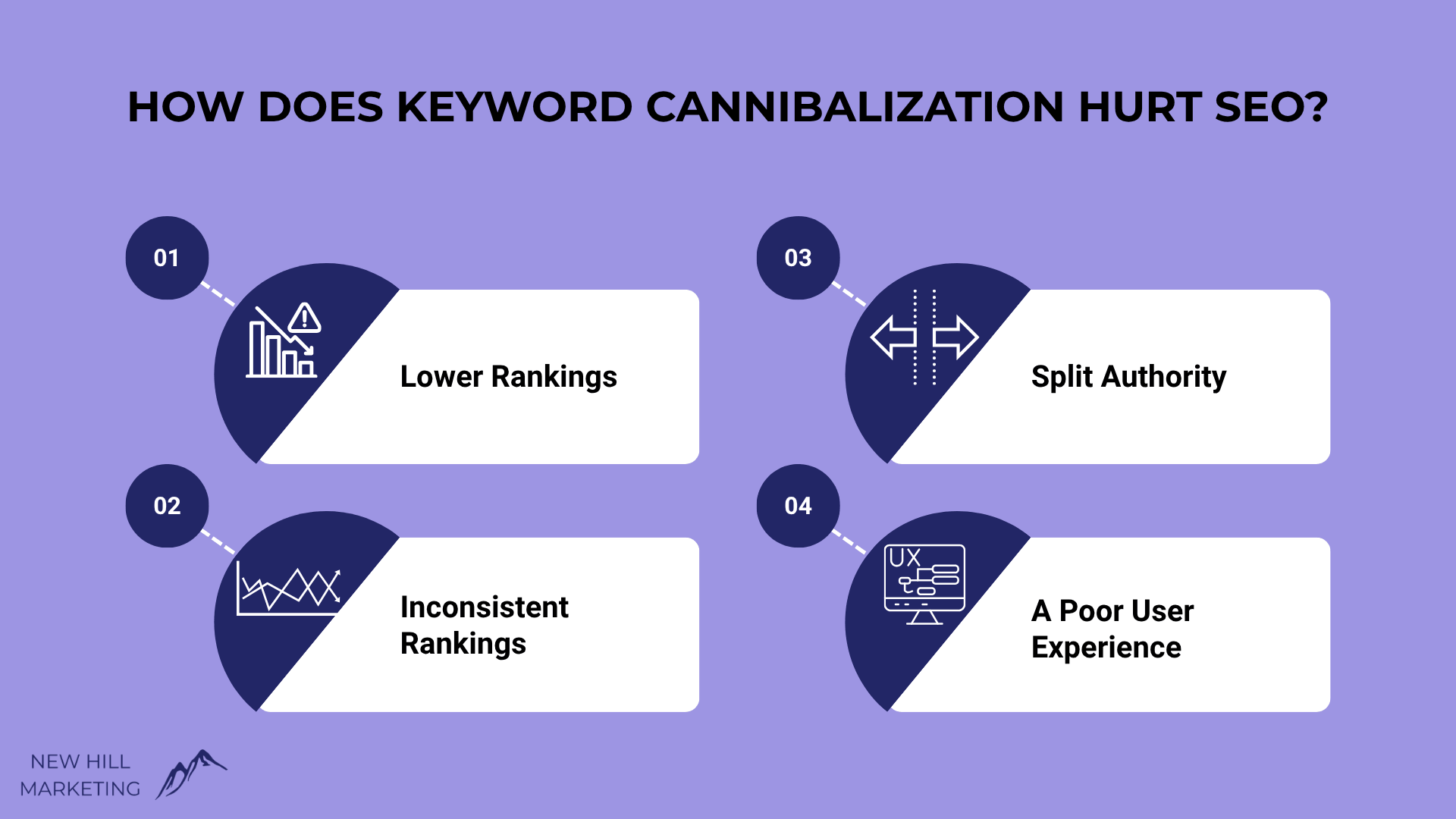
When multiple pages compete for the same search intent, several things can happen.
Lower Rankings
Instead of one highly authoritative page, Google sees multiple pages covering nearly identical topics.
The ranking signals become divided, making it harder for any single page to perform as well as it could.
Split Authority
Backlinks, internal links, and user engagement may become spread across several similar pages.
Rather than strengthening a single resource, your authority is diluted across multiple URLs.
Inconsistent Rankings
You may notice different pages ranking for the same keyword from week to week.
One month your blog post ranks. The next month your service page appears instead.
Neither page gains long-term momentum because Google continues evaluating which one best satisfies the search.
A Poor User Experience
Visitors may encounter multiple articles that say nearly the same thing.
Instead of creating a clear content journey, you're asking users and search engines to sort through duplicate information.
Google Isn't Confused
You'll often hear people say that keyword cannibalization "confuses Google."
That's an oversimplification. Google understands your pages remarkably well.
The issue is actually prioritization.
When several pages provide nearly identical value for the same search, Google has to determine which one deserves to rank highest. If there isn't a clear winner, your ranking signals are split across multiple pages.
Creating one stronger, more comprehensive page often gives Google a much clearer indication of which result deserves to appear first.
How to Identify Keyword Cannibalization
The good news is that finding keyword cannibalization is easier than many people think.
Search Your Website
One of the simplest methods is using Google itself.
Type: site:yourwebsite.com keyword
For example:
site:newhillmarketing.com keyword research
This shows every indexed page related to that topic.
If multiple pages cover nearly identical information, it's worth taking a closer look.
Check Google Search Console
Google Search Console lets you see which pages receive impressions and clicks for specific search queries.
If multiple URLs compete for the same keyword and serve the same intent, you may have a cannibalization issue.
Review Your Content Strategy
Sometimes you don't even need SEO tools.
Ask yourself:
Do I have multiple blogs answering the same question?
Have I written updated versions instead of improving the original?
Am I publishing content without checking what's already on my website?
As websites grow, overlapping topics become much more common.
How to Fix Keyword Cannibalization
Not every situation requires deleting pages. The best solution depends on why the overlap exists.
Merge Similar Content
If two articles cover nearly identical topics, combine them into one stronger resource.
Keep the page with the most authority, expand it with the best information from the second article, and redirect the old URL.
Improve Internal Linking
Sometimes Google simply needs clearer signals.
Link related articles together while making it obvious which page is your primary resource on the topic.
Create a Pillar Page
If several articles naturally belong together, consider creating a comprehensive guide that links to more detailed supporting articles.
This creates a clear content hierarchy that both users and search engines can understand.
Redirect Outdated Pages
If an older article no longer provides unique value, redirect it to the stronger, more up-to-date version.
This preserves existing authority while consolidating ranking signals.
How to Avoid Keyword Cannibalization
Preventing keyword cannibalization is much easier than fixing it later.
Here are a few habits that make a big difference.
Assign One Primary Keyword Per Page
Every important page should have one clear primary keyword and one primary search intent.
That doesn't mean it can only rank for one keyword; it simply gives the page a defined purpose.
Keep a Keyword Map
Maintain a spreadsheet of every important page along with its primary keyword.
Before publishing something new, check whether you've already covered that topic.
Audit Your Content Regularly
As your website grows, revisit older articles. Some may need updating, merging, or redirecting to strengthen your overall SEO strategy.
Write With Intent
Before starting a new article, ask yourself: Does this answer a question my website hasn't already answered?
If the answer is no, updating an existing page may yield better results than publishing a new one.
Keyword Cannibalization Isn't Always a Problem
One of the biggest mistakes I see is business owners panicking after an SEO tool flags "keyword cannibalization."
Remember: Multiple pages ranking for similar keywords isn't automatically bad.
If they're serving different audiences, answering different questions, or satisfying different search intent, there's often nothing to fix.
SEO tools are helpful, but they don't understand your content strategy the way you do.
That's why it's always important to evaluate the context before making major changes.
Why Choose New Hill Marketing?
At New Hill Marketing, we don't just run automated SEO reports and hand you a list of errors.
We manually review your website to identify real opportunities for growth, including keyword cannibalization, content gaps, internal linking opportunities, and technical SEO issues.
If we find pages competing with one another, we'll explain why it's happening, whether it's actually hurting your rankings, and exactly what steps to take next.
Whether you need a full website audit or ongoing SEO support, we're here to help you build sustainable, long-term growth. Reach out today, and we’ll help you sort out your content.
