

AI Ranking Tips: How to Create Content That AI (and People) Actually Want to Read

Everyone suddenly wants to talk about AI SEO.
AEO. GEO. LLMO. AI optimization.
But here's the truth:
Good SEO is still good SEO.
Google has been very clear that you don't need secret AI hacks or special files to rank in AI Overviews. What you do need is helpful, original content that genuinely answers people's questions.
If you're spending more time chasing buzzwords than creating valuable content, you're focusing on the wrong thing.
Here are a few simple ways to improve your AI ranking—without overcomplicating your SEO strategy.
Key Takeaways
AI ranking starts with strong SEO fundamentals, not AI "hacks."
Write content for people first, then optimize it for search engines.
Organize your content with clear headings and easy-to-scan sections.
Add original insights and real-world experience that AI can't recreate.
Include FAQs and answer common questions directly.
Focus on creating one excellent resource instead of dozens of similar pages.
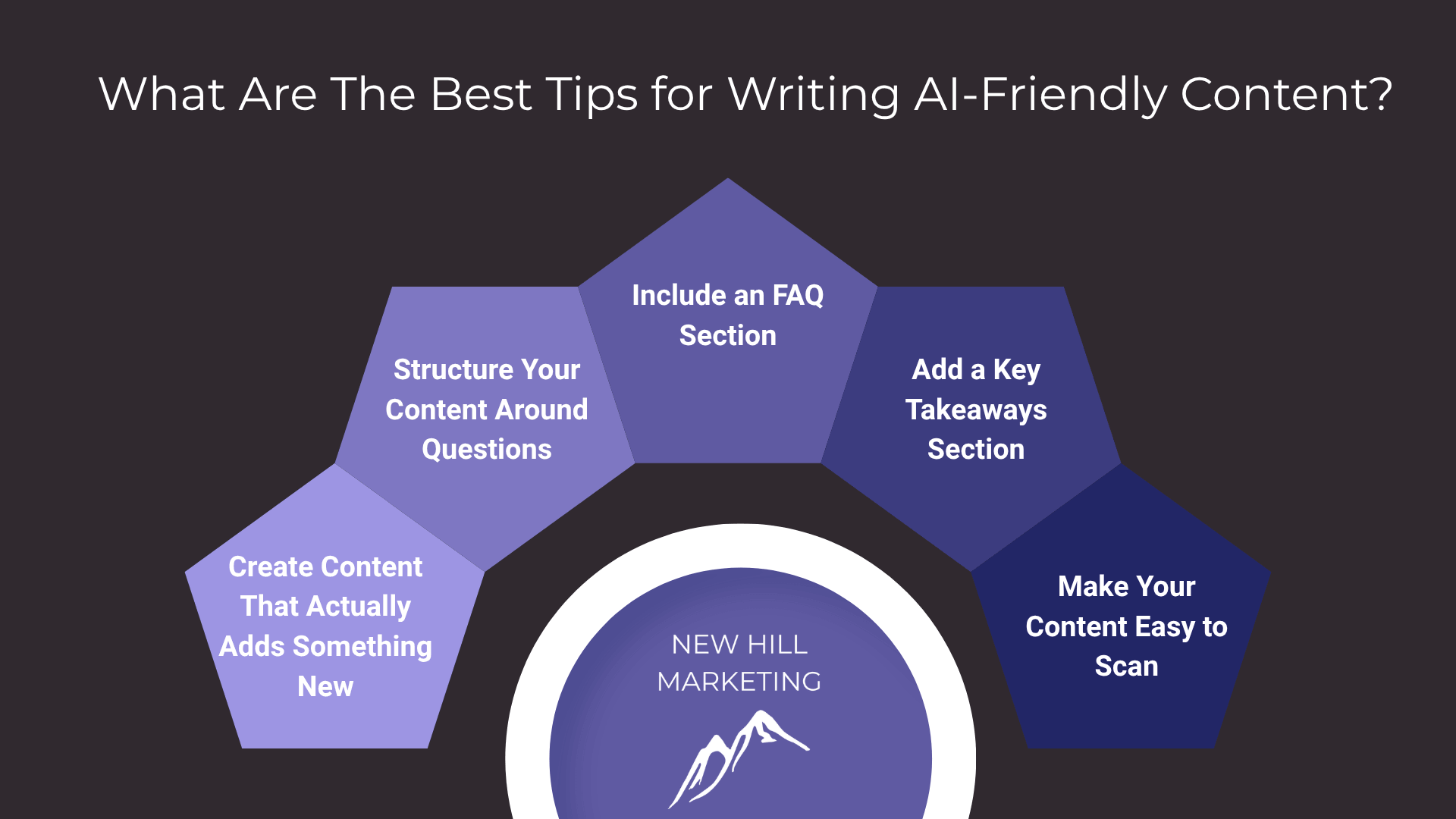
What Are The Best Tips for Writing AI-Friendly Content?
The good news is that you don't need to reinvent your content strategy to improve your AI ranking. A few thoughtful adjustments can make your content easier for both readers and search engines to understand.
1. Create Content That Actually Adds Something New
This is probably the biggest takeaway from Google's recent guidance. AI doesn't need another article that simply repeats what every other website has already said.
Instead, Google encourages websites to create non-commodity content: content that offers a unique perspective, personal experience, original research, or practical advice that readers can't get anywhere else.
Before you publish a new blog, ask yourself:
What can I add that other articles don't?
Have I actually experienced this?
Can I share real examples or results?
Am I simply summarizing other websites?
If your article could have been written by copying five other blogs together, it's probably not adding much value.
2. Structure Your Content Around Questions
One thing I've started doing more often is organizing content around the questions people are actually asking.
Instead of generic headings like "Benefits" or "Overview," use actual questions as your H2’s.
This blog is a perfect example of this.
We have the
H2: “What Are The Best Tips for Writing AI-Friendly Content?”
and then we have five H3’s:
H3: 1. Create Content That Actually Adds Something New
H3: 2. Structure Your Content Around Questions
H3: 3. Include an FAQ Section
H3: 4. Add a Key Takeaways Section
H3: 5. Make Your Content Easy to Scan
This question-and-answer structure makes your content easier for readers to scan while helping search engines quickly understand what each section covers. This is what I mean when I say that writing good SEO means creating good content to rank for AIs.
3. Include an FAQ Section
One of the easiest ways to make your content more helpful is by adding a Frequently Asked Questions section.
FAQs naturally answer the follow-up questions readers have after finishing your article.
Not sure what to include?
Head over to Google's People Also Ask section. Those questions come directly from real searches and are often the same follow-up questions people ask AI tools.
Answering them helps create a more complete resource.
4. Add a Key Takeaways Section
Not everyone has time to read an entire article, or they want to make sure the one they’re reading will answer their questions.
That's why I include a Key Takeaways section near the beginning of almost every blog I write.
A short bulleted summary lets readers understand the main points in just a few seconds.
If someone reads only that section, they should still leave with the key takeaways. It’s great for search engines and for potential customers.
5. Make Your Content Easy to Scan
People don't read websites the way they read books.
They scan.
Help them by making your content easy to digest:
Keep paragraphs short.
Use descriptive headings.
Break up long sections with bullet points.
Highlight important information naturally.
Avoid large walls of text.
The easier your content is to read, the more likely people are to stay on the page, and that's good for both your visitors and your SEO.
Don't Chase AI Hacks
There's been no shortage of "AI optimization" advice lately.
You've probably seen recommendations telling you to:
Add an llms.txt file.
Rewrite every article specifically for AI.
Break your content into tiny "chunks."
Stuff every possible keyword variation into one page.
The problem? Google has publicly said these tactics aren't necessary for ranking in its AI search experiences.
Instead, it recommends sticking with the fundamentals:
Create original content.
Build a technically sound website.
Write for people first.
Organize your information clearly.
Focus on delivering real value.
In other words, the same SEO best practices that have worked for years still matter today. Don’t get stuck with an SEO agency that’s giving you red flags.
AI Ranking Starts With Great Content
If you're wondering how to rank on AI, the answer is surprisingly simple. Don't try to outsmart Google's AI.
Help it.
Write content that's genuinely useful. Share real experience. Answer questions clearly. Organize your pages so readers can quickly find what they’re looking for.
That's exactly the type of content Google says it wants to surface in both traditional search results and AI Overviews.
The technology is changing quickly, but the goal hasn't changed at all: Create content that deserves to be found.
Why Choose New Hill Marketing?
At New Hill Marketing, we don't believe in chasing every new marketing buzzword.
Instead, we focus on building long-term SEO strategies that work today and continue working as search evolves. That means creating helpful, people-first content, improving your website's technical foundation, and making sure your content is structured in a way that's easy for both visitors and search engines to understand.
Whether you're trying to improve your organic rankings, appear in AI Overviews, or build a content strategy that stands the test of time, we're here to help.
Ready to create content that works for both people and AI? Let's talk.
Frequently Asked Questions about AI Ranking
What is AI ranking?
AI ranking refers to how content is selected and surfaced in AI-powered search experiences, such as Google's AI Overviews. The best way to improve AI ranking is by creating helpful, original content that follows strong SEO best practices.
How do you rank in AI Overviews?
There isn't a special trick to ranking in AI Overviews. Google recommends focusing on high-quality content, technical SEO, a great user experience, and unique insights that provide real value to readers.
What are some tips for writing AI-friendly content?
Write for people first, answer common questions, use clear headings, include FAQs and key takeaways, and share original expertise rather than repeating information already available everywhere else.
Do I need an llms.txt file to rank in AI?
No. Google has confirmed that it does not use llms.txt files for Search or AI Overviews, so adding one won't improve your rankings.
Is SEO still important for AI search?
Absolutely. Google has stated that traditional SEO best practices remain the foundation for visibility in both classic search results and AI-powered search experiences. Strong SEO is still the best long-term strategy.
