

SEO Red Flags: How to Spot an SEO "Expert" Before They Cost You Thousands

I recently shared a simple piece of advice on LinkedIn:
"Pro tip for hiring an SEO specialist: run away as fast as you can if they promise you results within 30 days."
I didn't expect the post to take off, but it reached more than 35,000 people, generated 495 reactions, 128 comments, and 42 reposts.
Clearly, it struck a nerve.
The truth is, business owners are tired of unrealistic promises. They're tired of hearing they'll rank on page one overnight or that SEO is guaranteed to transform their business in a matter of weeks.
That's simply not how SEO works.
Can SEO deliver incredible long-term results? Absolutely. But no agency can guarantee rankings or promise success on a specific timeline.
Unfortunately, I see the consequences of those promises all the time.
Someone reaches out after a website migration because their traffic suddenly disappeared. They tell me they hired an "SEO expert" who promised a perfect migration and better rankings. Instead, their impressions dropped, clicks slowed, and leads followed.
In many cases, those losses are preventable.
It's frustrating for business owners, and it gives honest SEO professionals a bad reputation.
That's why I put this guide together.
Whether you're hiring an SEO agency for the first time or wondering if your current one is the right fit, here are the biggest red flags I look for before trusting anyone with my website.
Key Takeaways
Legitimate SEO agencies never guarantee rankings or results.
Sustainable SEO takes time, and 30-day promises are a major red flag.
Good SEO focuses on qualified traffic, leads, and revenue, not vanity metrics.
Buzzwords don't equal expertise. Ask for strategy, not trendy acronyms.
A trustworthy SEO professional should be transparent about their process, expectations, and reporting.
The right SEO partner educates you instead of relying on fear or unrealistic promises.
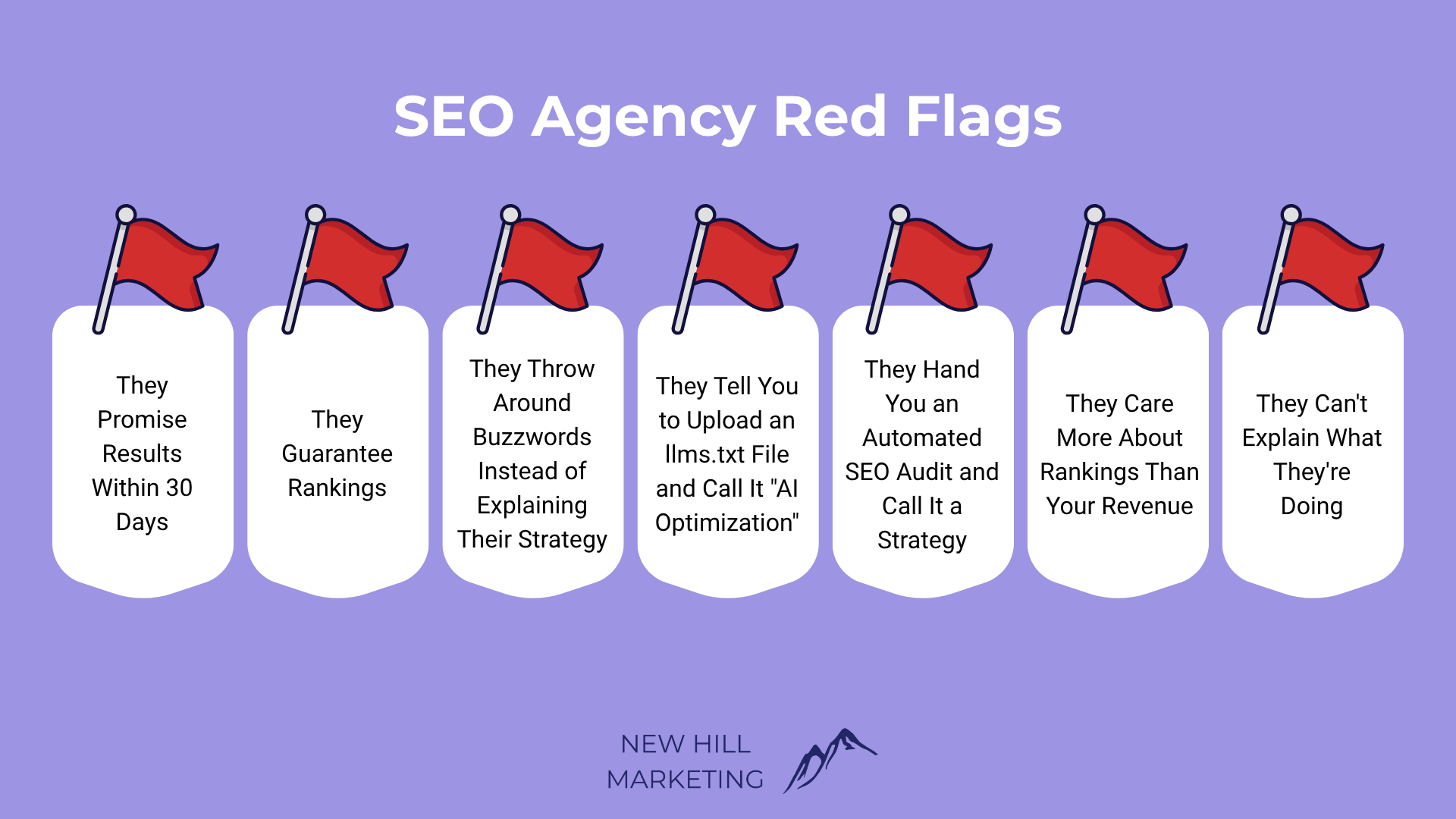
Red Flag #1: They Promise Results Within 30 Days
If you only remember one thing from this article, let it be this:
No legitimate SEO professional can guarantee meaningful results within 30 days.
That doesn't mean nothing will happen during the first month. In fact, much of the important work happens early on. A good SEO strategy usually starts with technical audits, keyword research, competitor analysis, content planning, on-page optimization, and fixing issues that may be holding your website back.
Those improvements matter.
But they also take time to be discovered, crawled, indexed, and evaluated by search engines.
The Uncertainty of Search Engine Algorithms
Google doesn't instantly reward a website because someone updated a few title tags or published a blog post. Search engines need time to process changes, compare your content against competitors, and determine whether your site deserves higher visibility.
Even then, rankings aren't determined by your website alone. They're influenced by your competitors, your industry, your website's history, the quality of your content, your authority, search intent, algorithm updates, and dozens of other factors that nobody outside of Google controls.
That's why honest SEO professionals set expectations rather than make guarantees.
If an agency confidently tells you they'll have your website ranking on the first page in 30 days, they're either oversimplifying SEO or telling you what they think you want to hear.
Neither is a good sign.
I actually shared this opinion on LinkedIn, and it resonated far more than I expected. The post reached over 35,000 people, generated 495 reactions, 128 comments, and was shared 42 times. Clearly, this is something business owners are tired of hearing.
The response to that post wasn't surprising to me.
Most experienced SEO professionals agreed.
Because we've all had to clean up after someone who overpromised and underdelivered.
Why Nobody Can Guarantee SEO Results
Here's the reality:
No SEO agency works for Google.
We don't get special access.
We can't flip a switch.
We can't manually move your website higher in search results.
Google's algorithm considers hundreds of ranking signals, many of which are constantly changing. On top of that, your competitors are also improving their websites, publishing content, earning backlinks, and investing in SEO.
There are simply too many variables for anyone to guarantee a specific outcome.
If someone says they can, they're either misleading you or not fully understanding how SEO works.
A Good SEO Agency Sets Expectations, Not Guarantees
There's a huge difference between making a promise and setting realistic expectations.
A trustworthy SEO partner should be able to tell you things like:
What opportunities they see.
What challenges they expect.
Which improvements they'll prioritize first.
Approximately how long SEO typically takes.
How they'll measure progress along the way.
Notice what's missing?
Guarantees.
Instead of saying:
"You'll rank #1 in 30 days."
A good agency says:
"Based on what we're seeing, here's the strategy we'd recommend. We'll follow SEO best practices, monitor performance closely, and adjust as we learn what works for your business."
Red Flag #2: They Guarantee Rankings
This one goes hand in hand with the 30-day promise.
If an SEO agency tells you they'll get you to the #1 spot on Google or guarantee you'll rank on the first page, it's time to start asking questions.
The reality is simple: no one controls Google's search results except Google.
An experienced SEO professional can absolutely improve your chances of ranking well. We can optimize your website, create helpful content, improve your technical SEO, and develop a strategy grounded in years of experience and proven best practices. We can even promise that we’re going to do everything in our power to try to rank in the #1 spot.
What we can't do is guarantee where Google will place your website.
Think about everything that affects search rankings:
Your competitors are constantly improving their websites.
Google updates its algorithm thousands of times every year.
Search intent changes over time.
Your website's history and authority matter.
Content quality, user experience, and technical health all play a role.
Even local competition can change overnight.
There are simply too many moving pieces for anyone to honestly promise a specific ranking.
But What If They Say They've Done It Before?
This is where things can get a little misleading.
An agency may tell you they've ranked dozens of websites on the first page, and that may very well be true. All of my SEO clients rank on the first page for valuable search terms.
Still, I’m the first to say: past success is a great sign that they know what they're doing, but it's not proof we can guarantee the same outcome for your business.
Every website starts from a different place.
Maybe your competitor has been building authority for 15 years. Maybe you're launching a brand-new website. Maybe you're trying to rank for one of the most competitive keywords in your industry.
Those situations all require different strategies, timelines, and expectations.
Good SEO professionals understand that. We won't pretend every business follows the exact same path.
Red Flag #3: They Throw Around Buzzwords Instead of Explaining Their Strategy
Every few months, it seems like the SEO industry invents a new acronym.
AEO. GEO. AIO. LLMO.
Lately, AI has only accelerated the trend.
Now, don't get me wrong, AI search is absolutely changing how people find information online. Google AI Overviews, ChatGPT, and other large language models are changing search behavior, and businesses should be paying attention.
But here's where I start to get skeptical.
If an agency spends more time talking about trendy acronyms than explaining how they're actually going to grow your business, that's a red flag.
At New Hill Marketing, we believe that if you hire us, you deserve to understand exactly what we're doing and why we're doing it. SEO shouldn't feel like a secret club where only marketers understand the language.
The Fundamentals Haven't Changed
Yes, search is evolving; it’s always evolving. AI is becoming a bigger part of how people discover information online.
But the fundamentals of good SEO haven't suddenly disappeared.
Google, ChatGPT, and other AI-powered search tools all want to surface content that is:
Helpful
Accurate
Unique
Well-organized
Easy to understand
Written by someone with genuine knowledge or experience
Technically accessible
Notice what's missing?
There's no magic "AI optimization" button.
There isn't a secret checklist that suddenly makes your website appear in every AI-generated answer. The businesses seeing success today are usually the ones that have been following SEO best practices all along.
Red Flag #4: They Tell You to Upload an llms.txt File and Call It "AI Optimization"
This is one of the newest red flags I've started seeing.
I've already come across agencies advertising "AI optimization" services that revolve around adding an llms.txt file to your website.
They make it sound like it's the missing piece that will suddenly get your business featured in ChatGPT, Google AI Overviews, or every other AI search engine.
The reality? You simply don’t need it.
So, What Is an llms.txt File?
An llms.txt file is a proposed standard that's designed to help AI systems better understand and access content on a website.
The idea is interesting, and it may become more important as AI search continues to evolve.
But here's the important part: There is currently no evidence that simply adding an llms.txt file will improve your visibility in AI search.
Google’s own John Mueller even states that you don’t need LLMs.txt, so don’t get tricked into thinking you do.
Real AI Visibility Comes From Great Content
If your goal is to appear in AI-generated answers, the focus should still be on creating content that's genuinely useful.
That means:
Answering real customer questions.
Demonstrating expertise.
Structuring your content clearly.
Adding value and creating unique content with your perspective.
Using descriptive headings.
Keeping your information accurate and up to date.
Making sure your website is technically sound.
Those are the things that have always mattered.
The technology may be changing, but quality content is still the foundation.
Red Flag #5: They Hand You an Automated SEO Audit and Call It a Strategy
This one is a big pet peeve of mine.
I can't tell you how many people have reached out after receiving a 50-page "SEO audit" from another agency, convinced their website is completely broken.
Or worse, they’ve run it through a generative AI, and it spat out a report of things it thinks you need.
When I open the report, it's almost always the same thing.
A tool-generated PDF.
No explanation.
No prioritization.
No strategy.
Just pages and pages of warnings with lots of red, orange, and yellow circles designed to make the website owner panic.
An SEO Tool Isn't an SEO Strategy
Don't get me wrong, I use SEO tools every single day.
They're incredibly valuable. They help identify technical issues, monitor rankings, crawl websites, and uncover opportunities.
But they're only tools. They don't know your business, your customers, or your goals.
And they certainly can't tell you which issues actually matter.
Every Website Has "Problems"
Here's something most agencies won't tell you: I've never audited a website that scored 100%.
Ever. And it won’t ever happen.
Even websites that dominate search results have technical issues.
They might have:
Missing alt text
Duplicate meta descriptions
Broken internal links
Redirect chains
Slow-loading images
Pages with thin content
Schema opportunities
That's completely normal.
An automated audit doesn't tell you whether those issues are actually hurting your business.
It simply tells you they exist.
Red Flag #6: They Care More About Rankings Than Your Revenue
Here's a question I ask almost every prospective SEO client:
"What does success look like to you?"
The answer is almost never:
Ranking #1 on Google
Getting 100,000 monthly visitors
Having a Domain Authority of 70
Instead, people tell me they want:
More qualified leads
More phone calls
More form submissions
More booked appointments
More sales
That's the difference.
Good SEO agencies focus on growing your business.
Bad SEO agencies focus on growing numbers that look impressive in a report.
Rankings Don't Pay the Bills
Don't get me wrong, rankings matter. If your website isn't visible, people can't find you. But rankings are only valuable if they're bringing in the right people.
Would you rather:
Rank #1 for a keyword that brings 10,000 visitors who never buy…
Or
Rank #4 for a keyword that consistently brings customers who are ready to hire you?
The second option wins every single time, and that’s the type of SEO we want to do.
SEO isn't about attracting everyone. It's about attracting the right people.
Red Flag #7: They Can't Explain What They're Doing
SEO can get technical.
There are conversations about crawl budgets, structured data, canonical tags, Core Web Vitals, AI search, and dozens of other topics that can make your head spin.
But here's the thing: just because SEO is technical doesn't mean your SEO agency should make it confusing.
If you constantly leave meetings wondering, "What did we actually accomplish?" or "What am I paying for?" that's a problem.
A good SEO partner should educate you, not overwhelm you.
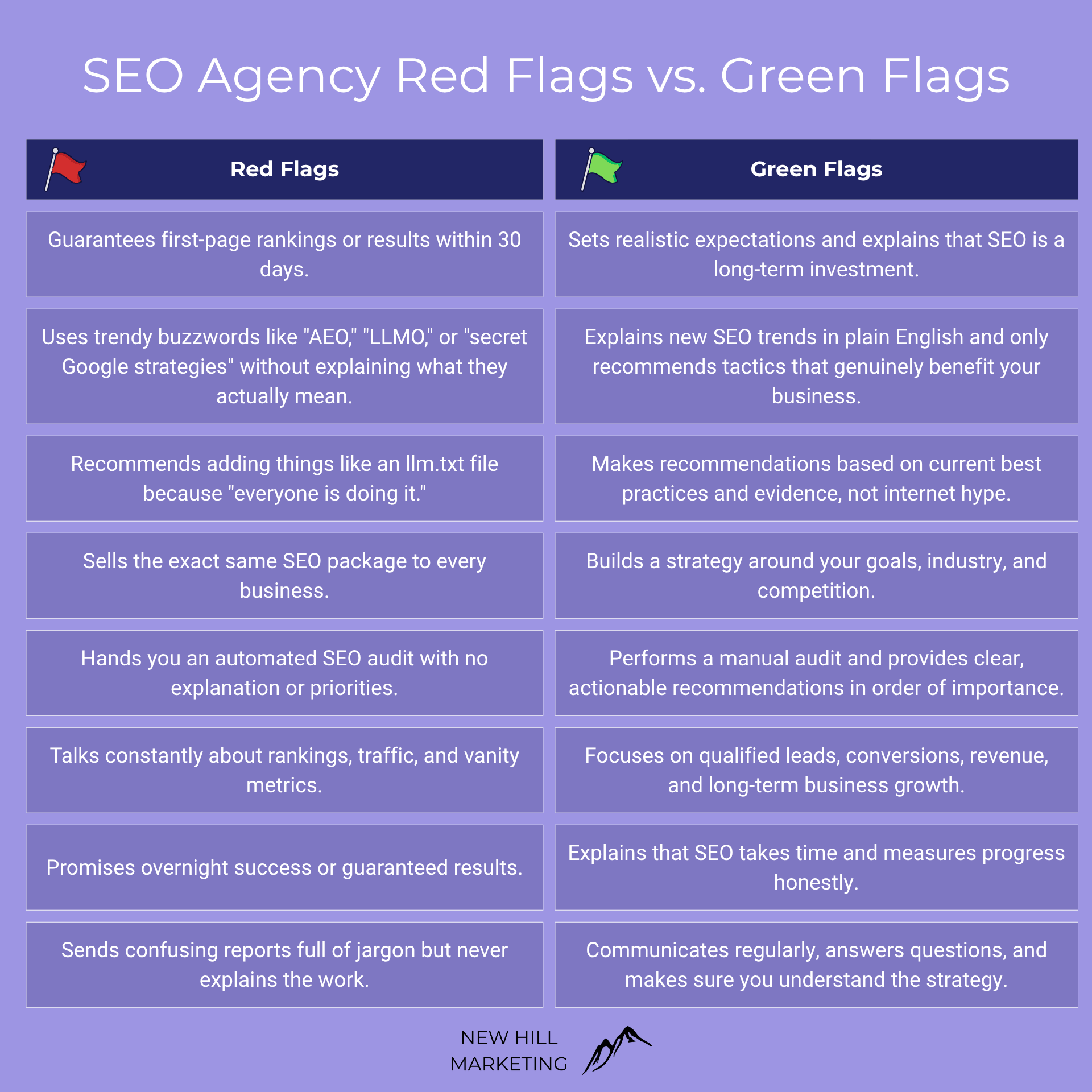
Green Flags to Look for Instead
By now, we've covered plenty of warning signs. So what should you actually look for when choosing an SEO partner?
Here are a few green flags that tell you're probably talking to someone who knows what they're doing:
They set realistic expectations instead of making guarantees.
They explain their strategy in language you can understand.
They customize recommendations for your business instead of selling cookie-cutter packages.
They focus on leads, conversions, and business growth, not just rankings.
They provide manual audits with clear priorities, not just automated reports.
They communicate regularly and welcome your questions.
They're honest about what they know and what they don't.
Nobody has Google's algorithm figured out. Anyone who tells you otherwise is selling something.
The best SEO professionals aren't the ones making the biggest promises.
They're the ones consistently doing great work, adapting as search evolves, and helping your business grow over time.
Choose an SEO Partner, Not Just an SEO Provider
Hiring someone to manage your SEO is a big decision.
The right partner can help your business build sustainable visibility, generate qualified leads, and create long-term growth. The wrong one can cost you months of progress, thousands of dollars, and a lot of unnecessary frustration. I’ve seen it happen time and time again.
Ready for Honest SEO Advice?
At New Hill Marketing, we believe great SEO starts with honesty.
We'll never promise overnight rankings or guaranteed results. Instead, we'll take the time to understand your business, develop a strategy aligned with your goals, and explain every recommendation along the way.
If you're looking for an SEO partner who values transparency, communication, and long-term growth, we'd love to chat.
Reach out today for a conversation about your website, and let's build a strategy that's designed to last, not just impress you during the sales call.
Frequently Asked Questions
How long does SEO actually take?
It depends on your website, your competition, and your industry. Some improvements can happen within a few weeks, but meaningful, long-term SEO growth often takes several months. If someone promises first-page rankings in 30 days, that's a major red flag.
I typically say that for a brand-new website, expect to start seeing results in 6 months. SEO is a marathon, not a sprint. If you’re looking for more immediate results, consider running paid ads.
Can an SEO agency guarantee results?
No. No agency can control Google's algorithm or guarantee rankings. A trustworthy SEO partner will set realistic expectations, explain their strategy, and measure progress over time, not make promises they can't keep.
Is ranking #1 on Google the most important goal?
Not necessarily. Ranking higher is great, but the real goal is attracting qualified visitors who become leads and customers. We'd rather help you rank for keywords that generate business than chase rankings that don't move the needle.
How can I tell if an SEO agency is legitimate?
Ask for case studies, examples of past work, and a clear explanation of their strategy. A reputable agency should be transparent about their process, communicate regularly, and explain recommendations in plain English.
Should I choose the cheapest SEO agency?
Not always. While every business has a budget, extremely low-cost SEO often means cookie-cutter strategies, outsourced work, or automated reports with very little real optimization. Good SEO takes time, experience, and ongoing effort.
What questions should I ask before hiring an SEO agency?
Ask how they measure success, who will actually be working on your account, how often you'll communicate, what their strategy looks like, and how they handle reporting. Their answers will tell you a lot about how they operate.
What if I've already hired the wrong SEO agency?
You're not alone. We regularly work with businesses that have had disappointing experiences with previous agencies. The first step is to understand where things went wrong, then build a strategy based on your goals rather than quick fixes or empty promises.
How do I know if my current SEO agency is doing a good job?
Look beyond rankings and traffic. Ask whether your website is generating more qualified leads, whether your organic visibility is improving, and whether your agency can clearly explain the work they're doing each month. If you're getting vague reports and no real communication, it may be time for a second opinion.
