

What Is a Website Audit? Here’s What We Do For Our Clients

Your website might look great on the surface, but that doesn't always mean it's performing the way it should. Hidden technical issues, outdated content, slow pages, or SEO mistakes can quietly cost you rankings, traffic, and leads without you ever noticing.
That's where a website audit comes in.
A website audit gives you a complete picture of your website's health. It helps identify what's working, what's holding your site back, and what improvements will have the biggest impact. Whether you're trying to improve your SEO, generate more leads, or prepare your website for AI-powered search, regular audits are one of the smartest investments you can make.
In this guide, we'll explain what a website audit is, the different types of audits, and how they can help your website perform better.
Key Takeaways
A website audit is a complete health check of your website that identifies technical, SEO, content, and user experience issues.
Different types of audits focus on different areas, including technical SEO, content, conversions, accessibility, and AI search readiness.
Regular website audits help improve search rankings, website performance, and lead generation.
Modern website audits should evaluate both traditional SEO and AI visibility through GEO (Generative Engine Optimization).
A website audit report prioritizes issues, so you know exactly what to fix first instead of guessing.
Most businesses should perform a website audit at least once a year, or after major website updates.
What Is a Website Audit?
A website audit is a thorough evaluation of your website that assesses how well it's performing from both user and search engine perspectives. Think of it like a routine health check. Instead of checking your blood pressure or heart rate, you're checking your website's speed, content, technical setup, SEO, user experience, and overall performance.
We don’t perform a website audit solely to find issues. We take a neutral, unbiased approach to reviewing the website so we can analyze its performance and make decisions that will help it improve.
A thorough website audit can answer questions like:
Why has my traffic dropped?
Why aren't my pages ranking?
Why aren't visitors converting into customers?
Is my website easy for Google and other search engines to crawl?
Is my content still relevant?
Is my website ready for AI-powered search?
By answering these questions, a website audit provides a roadmap for improving your website instead of relying on guesswork.
The best part? Audits aren't just for websites with obvious problems. Even websites that appear to be performing well often have hidden issues that quietly impact rankings, user experience, and conversions.
[CALL TO ACTION]
Why Website Audits Matter
Your website is never truly "finished."
Search engines change their algorithms. In fact, Google makes thousands of changes to its algorithm every year. If you hit publish on your site, then never touch it again, you’re going to start running into issues sooner rather than later.
Without regular maintenance, small issues begin to add up.
You might have:
Broken internal links
Pages that load too slowly
Outdated service information
Missing metadata
Duplicate content
Poor mobile usability
Old blog posts that no longer reflect your expertise
None of these issues may seem significant on their own. But together, they can gradually reduce your visibility in search results and create a frustrating experience for visitors.
A website audit helps you catch these problems before they become expensive ones. More importantly, audits help you discover opportunities you may have overlooked.
For example, you may find:
High-performing pages that could rank even better with a few updates.
Content that can be expanded into an entire topic cluster.
Technical fixes that improve page speed across your entire website.
Pages that receive plenty of traffic but generate very few leads.
New opportunities to appear in Google's AI Overviews or AI-powered search experiences.
Rather than making random changes, a website audit gives you a clear, prioritized plan for improving your website based on real data.
What Does a Website Audit Check?
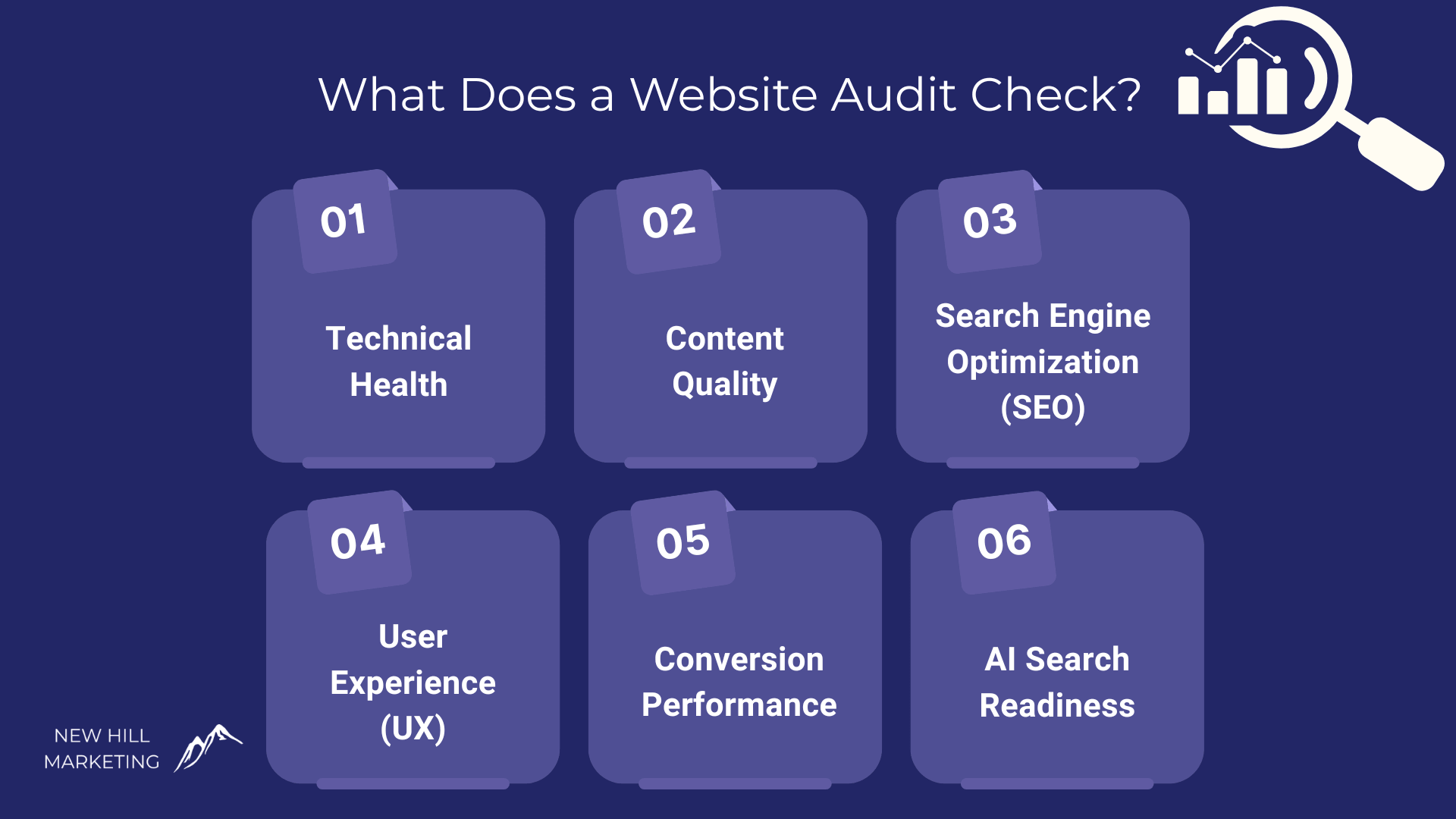
There's no single checklist that every website audit follows. Instead, a comprehensive audit examines several different areas of your website to understand how everything works together.
Here’s what our website audit typically looks at.
Technical Health
This focuses on how search engines access and understand your website.
Technical audits look at things like:
Crawlability and indexing
XML sitemaps
Robots.txt files
Broken links
Redirects
Canonical tags
HTTPS security
Core Web Vitals
Mobile usability
Structured data (Schema)
Without a solid technical foundation, even the best content can struggle to rank.
Content Quality
Your content is one of the biggest factors influencing both search rankings and customer trust. Without content, search engines don’t have anything to crawl so you can rank.
A website content audit evaluates whether your content is still useful, accurate, and aligned with what your audience is searching for.
It typically reviews:
Outdated information
Duplicate pages
Thin content
Keyword targeting
Search intent
Internal linking
Readability
Opportunities to refresh existing pages
Sometimes improving existing content delivers better results than creating something entirely new.
Search Engine Optimization (SEO)
Personally, this is my absolute favorite part of a website audit. An SEO review looks at how well your website is optimized to appear in search results.
This includes evaluating:
Keyword usage
Title tags
Meta descriptions
Heading structure
Image optimization
Internal links
Indexability
Organic rankings
SEO isn't just about adding keywords anymore. Today's search engines reward websites that are helpful, organized, and trustworthy.
User Experience (UX)
Google wants to recommend websites that people actually enjoy using. That's why website audits also evaluate your user experience.
This includes reviewing:
Navigation
Mobile responsiveness
Page speed
Accessibility
Readability
Contact forms
Calls-to-action
Overall usability
If visitors can't quickly find what they're looking for, they're likely to leave, even if your website ranks well.
Conversion Performance
Getting visitors to your website is only half the battle.
A good audit also assesses how effectively your website converts visitors into leads or customers.
This includes evaluating:
Contact forms
Landing pages
Calls-to-action
Trust signals
Testimonials
Conversion paths
User behavior
If your site gets a ton of traffic, but you’re not seeing leads come through, that’s a problem, and that’s what our conversion performance checks are for.
AI Search Readiness
Love it or hate it, AI is here, and we have to include it in our audits. Now, Google has come out and created clear guidelines for AI optimization, so while you’ll hear a lot of buzzwords from other companies, we keep this clean and streamlined.
We know that good SEO makes your site good for AI, and we follow that. However, our AI search readiness portion of our audit may review:
AI crawler accessibility
Content clarity
Entity optimization
AI-friendly page structure
SEO BEST PRACTICES!!!!
What Is a Technical Audit for an SEO Website?
Think of a technical SEO audit as checking everything behind the scenes of your website.
Your visitors may never notice these issues directly, but search engines do. If Google can't properly crawl, understand, or index your site, it doesn't matter how good your content is, it simply won't reach its full ranking potential.
A technical audit looks at how well your website is built and whether anything is preventing search engines from accessing your pages.
Some of the most common things a technical audit checks include:
Crawl errors
Indexing issues
Broken links
Redirect chains and loops
XML sitemaps
Robots.txt configuration
HTTPS security
Canonical tags
Duplicate content
Core Web Vitals
Mobile usability
Structured data (Schema markup)
Page speed
URL structure
For example, imagine you've written an amazing service page that perfectly answers your customer's questions. If that page has been accidentally blocked from indexing or takes 10 seconds to load, Google may never rank it as highly as it deserves.
That's why technical SEO forms the foundation of every successful SEO strategy.
Think of it like building a house. Before you decorate the rooms, you need a strong foundation. Technical SEO is that foundation.
What Is a Website Content Audit?
A website content audit focuses on the information your visitors actually read.
Instead of looking at code or website performance, it evaluates whether your content is still accurate, useful, and aligned with what your audience is searching for.
Over time, websites naturally collect outdated pages:
Old blog posts
Services you've stopped offering
Statistics that are no longer accurate
Pages that no longer rank
Duplicate articles competing against each other
A content audit helps clean all of that up.
During a content audit, you'll typically evaluate:
Which pages receive the most traffic
Which pages generate leads
Outdated information
Duplicate content
Thin or low-value pages
Keyword optimization
Search intent
Internal linking opportunities
Readability and user experience
From there, each page usually falls into one of four categories:
Keep: The content is performing well and doesn't need major changes.
Update: The page has potential but needs refreshed information, improved SEO, or expanded content.
Combine: Several pages cover nearly identical topics and should be merged into one stronger resource.
Remove: The page no longer provides value and should be redirected or deleted.
A content audit focuses on making your existing content work harder. Sometimes updating an older article is far more effective than writing a brand-new one.
What Is a GEO Website Audit?
As search continues to evolve, website audits are evolving too.
Our GEO audits evaluate how well your website performs in AI-powered search experiences like:
Google AI Overviews
ChatGPT
Google's AI Mode
Other AI search platforms
Some GEO tools also analyze how AI expands user questions into related searches, helping you discover entirely new content opportunities.
For example, if someone asks an AI assistant:
"What's the best roofing material?"
The AI may also explore related questions like:
Which roofing material lasts the longest?
Is metal roofing worth it?
What roofing is best for cold climates?
Understanding these expanded queries helps you create content that answers the full conversation, not just one keyword.

What Is a Website Audit Report?
A website audit report is the document you receive after completing an audit. Think of it as your website's report card.
Rather than simply pointing out problems, a good audit report explains:
What was reviewed
What issues were found
Why those issues matter
How to fix them
Which fixes should be prioritized
A comprehensive website audit report typically includes sections covering:
Technical SEO
On-Page SEO
Content Analysis
User Experience
AI Readiness
Prioritized Recommendations
Perhaps the most valuable section of any audit is the action plan because not every issue needs to be fixed immediately.
A quality website audit report helps you focus on the changes that will deliver the biggest improvements first, whether that's fixing technical errors, refreshing high-performing content, or improving slow-loading pages.
Instead of leaving you with a long list of problems, it provides a practical roadmap to make your website stronger over time.
At New Hill Marketing, we give you an easy-to-understand website audit report, and we schedule a call to go over the results and answer any and all questions so you fully understand the state of your website.
What Are The Signs Your Website Needs an Audit?
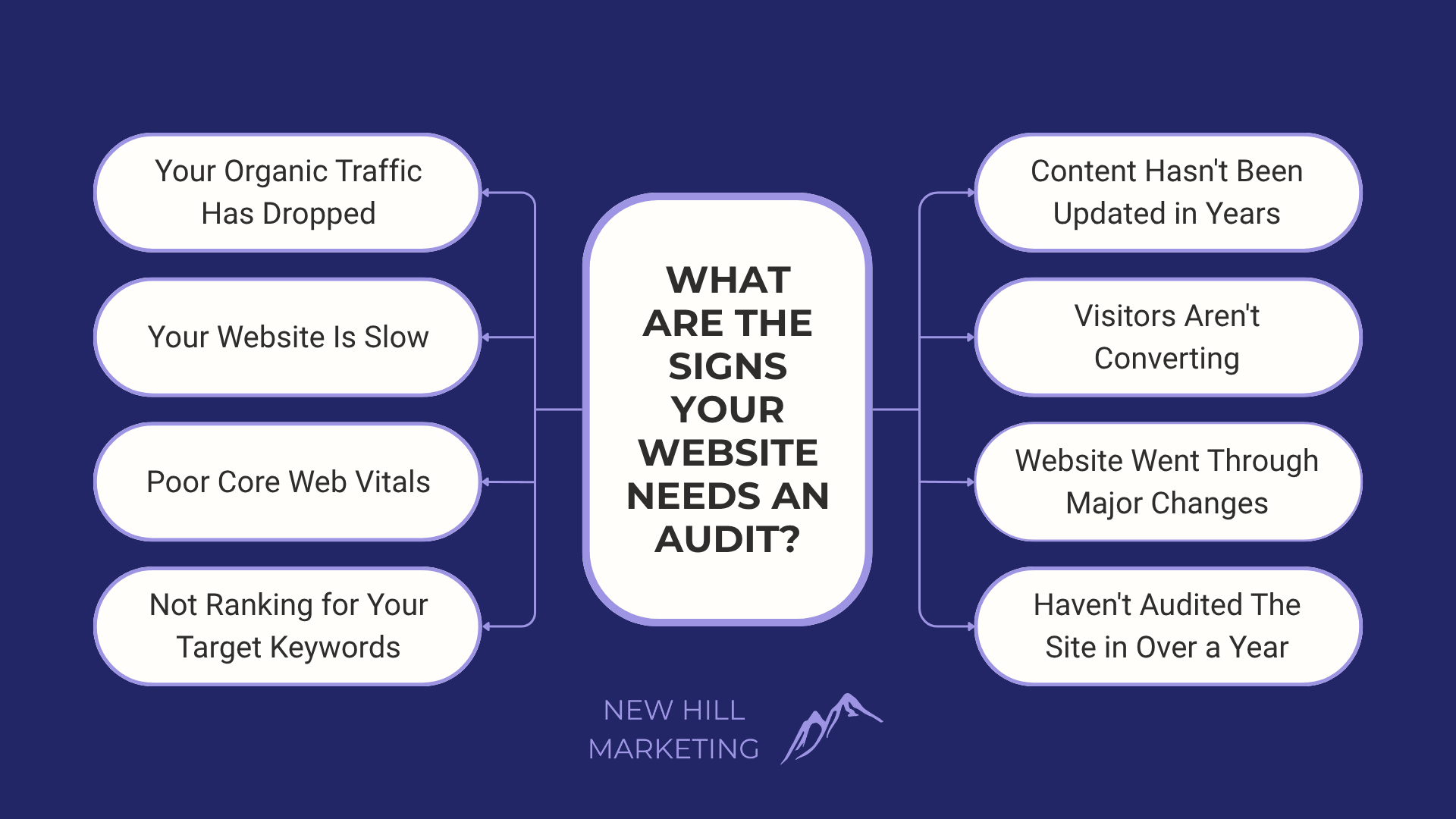
Not sure if it's time for a website audit? The truth is, most websites benefit from one at least once a year, if not twice. Search engines change, your business evolves, and small technical issues can quietly pile up over time.
If you're experiencing any of the following, it's probably time to take a closer look.
Your Organic Traffic Has Dropped
If your website used to receive steady traffic from Google but you've noticed a decline, an audit can help uncover why.
The cause could be:
Technical SEO issues
Lost keyword rankings
Outdated content
Broken pages
Recent Google algorithm updates
Rather than guessing what's wrong, an audit helps identify the root cause so you can fix it.
Your Website Is Slow
Website speed affects both user experience and SEO.
If your pages take too long to load, visitors are more likely to leave before they even see your content. Google also considers page speed when evaluating websites for search rankings.
A website audit can identify performance issues such as:
Large image files
Unused code
Slow hosting
Excessive plugins
Poor Core Web Vitals
Even small speed improvements can have a noticeable impact on user engagement and conversions.
You're Not Ranking for Your Target Keywords
Maybe you've invested time writing blog posts or optimizing service pages, but you're still not showing up in search results.
A website audit can reveal whether:
You're targeting the wrong keywords.
Multiple pages are competing for the same keyword (keyword cannibalization).
Your pages don't match search intent.
Competitors simply have stronger content.
Knowing why you're not ranking is the first step toward improving your visibility.
Your Content Hasn't Been Updated in Years
Content isn't something you publish once and forget.
Statistics become outdated. Services change. Search intent evolves. Even your competitors are constantly updating their websites.
Refreshing older pages often delivers better results than creating brand-new content from scratch. A content audit helps identify which pages should be updated, expanded, combined, or removed.
Visitors Aren't Converting
Traffic is great, but if no one is contacting you, requesting quotes, or making purchases, something is missing.
An audit looks beyond rankings to evaluate how well your website encourages visitors to take action.
This includes reviewing:
Calls to action (CTAs)
Contact forms
Navigation
User experience
Landing page messaging
Conversion paths
Your Website Has Gone Through Major Changes
Any significant update to your website is a good reason to perform an audit.
This includes:
A website redesign
Migrating platforms
Adding new services
Updating your navigation
Moving domains
Launching a large amount of new content
Even well-planned website changes can accidentally create broken links, duplicate pages, indexing issues, or missing metadata.
An audit helps catch these problems before they impact your rankings.
You Haven't Audited Your Website in Over a Year
Even if everything seems to be working, websites naturally drift over time.
New SEO best practices emerge. AI search continues to evolve. Google updates its algorithm thousands of times each year, including several major updates.
What worked two years ago may no longer be enough today.
Performing regular website audits helps keep your site healthy, competitive, and aligned with current best practices.

How to Perform a Website Audit
The good news is you don't need to fix everything at once.
A website audit works best when you approach it step by step. Instead of hunting for random problems, follow a structured process that looks at your website from both a technical and user perspective.
Here's how we recommend auditing your website.
Step 1: Crawl Your Website
Start by creating a complete inventory of your website.
SEO crawling tools scan every page on your site and identify technical issues that are difficult to spot manually.
This gives you a clear picture of every page, broken link, redirect, image, and metadata issue across your site.
Step 2: Check Technical SEO
Next, review your website's health behind the scenes.
Look for issues such as:
Crawl errors
Broken links
Missing title tags
Duplicate meta descriptions
Slow-loading pages
Mobile usability problems
Missing structured data
Indexing issues
Think of this as making sure your website's foundation is solid before improving anything else.
Step 3: Review Your Content
Now it's time to evaluate every important page on your website.
Ask yourself:
Does this page answer the user's question?
Is the information still accurate?
Does it target the right keyword?
Could it be expanded?
Is there another page covering the same topic?
Sometimes you don’t need to create new content; you just need to enhance the content you have to make it better.
Step 4: Evaluate User Experience
SEO gets people to your website. User experience determines whether they stay.
Review your website from the perspective of a first-time visitor:
Can they quickly find what they're looking for?
Is your navigation simple?
Are your calls to action obvious?
Is the page easy to read on both desktop and mobile?
Even small improvements to usability can lead to more leads and conversions. If you’re too close to your site, having a fresh set of eyes can help you see something you may have missed.
Step 5: Prioritize Your Fixes
Once you've identified the issues, resist the urge to tackle everything at once.
Instead, organize your findings by impact.
Start with the fixes that will make the biggest difference, such as technical errors preventing indexing, high-value pages that need updating, or slow-loading pages that are hurting user experience.
Why Choose New Hill Marketing for Your Website Audit?
A website audit should do more than hand you a long list of technical issues. It should give you a clear plan for improving your website and help you understand why those changes matter.
At New Hill Marketing, we take a comprehensive approach to every audit. We review your website page by page, looking at technical SEO, content, user experience, site structure, internal linking, page speed, and opportunities to improve your visibility in both traditional search engines and AI-powered search.
When we're finished, you'll receive a detailed report outlining exactly what we found, why it matters, and the recommended next steps to strengthen your website's SEO performance. We’ll even get on a call with you to explain everything we found and answer all of your questions.
And if you decide to partner with us for ongoing SEO or to implement the recommendations from your audit, we'll credit 50% of your website audit cost toward your future SEO services.
Our goal is to make it easy for you to understand what changes your website needs to attract more qualified visitors, generate more leads, and continue working for your business long after the audit is complete.
Ready to Find Out What's Holding Your Website Back?
Your website could have technical issues, outdated content, or missed SEO opportunities that are quietly limiting your visibility in search results. The good news is that you don't have to guess where the problems are.
At New Hill Marketing, we provide comprehensive website audits that give you a clear picture of what's working, what isn't, and exactly what to do next. Whether you plan to make the improvements yourself or want an experienced team to handle them, you'll leave with a practical roadmap to improve your website.
Ready to see how your website is performing? Contact New Hill Marketing today to schedule your website audit and start building a stronger foundation for your SEO.
Frequently Asked Questions About Website Audits
What is a website audit?
A website audit is a comprehensive review of your website's health, performance, and SEO. It examines technical issues, content quality, user experience, and search engine optimization to identify opportunities for improvement.
How often should you perform a website audit?
For most businesses, we recommend conducting a website audit at least once a year, if not twice. You should also perform an audit after a website redesign, a major content update, a domain migration, or a significant Google algorithm update.
What is a technical audit for an SEO website?
A technical SEO audit evaluates the behind-the-scenes elements that affect your search rankings, including crawlability, indexing, page speed, mobile usability, structured data, broken links, and other technical issues that may prevent search engines from properly understanding your website.
What is a website content audit?
A website content audit reviews the quality and performance of your existing pages. It helps identify outdated information, duplicate content, keyword opportunities, underperforming pages, and content that should be updated, combined, or removed.
What is a GEO website audit?
A GEO (Generative Engine Optimization) website audit evaluates how well your website is prepared for AI-powered search experiences, such as Google AI Overviews and ChatGPT. It looks at factors such as AI crawlability, structured data, semantic organization, and overall AI readiness to help improve your visibility in AI-generated search results.
What is included in a website audit report?
A website audit report typically includes technical SEO findings, content recommendations, user experience issues, page performance insights, and a prioritized action plan, so you know exactly what to address first.
How long does a website audit take?
It depends on the size and complexity of your website. Smaller websites can often be audited within a few hours, while larger websites with hundreds of pages may take several days to review thoroughly.
What's the difference between a website audit and an SEO audit?
The terms are often used interchangeably, but a website audit is usually broader. While an SEO audit focuses primarily on search performance, a complete website audit also reviews user experience, accessibility, site structure, content quality, conversions, and overall website health.
How much does a website audit cost?
The cost of a website audit depends on the size and complexity of your website. In general, the more pages your site has, the longer the audit takes. At New Hill Marketing, we review your website page by page, evaluating everything from technical SEO and content to user experience and AI search readiness. That means you receive a detailed, actionable report tailored to your website rather than a generic automated scan.
How can I get started with a website audit?
Getting started is easy. Simply reach out to New Hill Marketing, and we'll learn more about your website, your business goals, and any challenges you're experiencing. From there, we'll conduct a comprehensive website audit and provide you with a clear roadmap to improve your site's SEO, performance, and overall user experience.
And if you decide to partner with us for ongoing SEO or to implement the recommendations from your audit, we'll credit 50% of your website audit cost toward your future SEO services.
